

Year 3 Multiplication & Division: ACARA v9.0 Guide
🎯 The TLDR: Curriculum Expectations
- Recall multiplication facts for 2, 3, 5, and 10.
- Recall related division facts (the "Fact Family").
- Understand commutativity (3x4 = 4x3).
- Use the "Inverse" to solve division.
- Master the properties of 0 and 1.
ACARA v9.0 Links: AC9M3N04 (Recall facts), AC9M3N05 (Represent and solve).
Best Strategies for Multiplicative Thinking
In Year 3, we move students away from counting by ones toward Unitising—seeing a group as a single entity. Here are the three most effective classroom approaches:
Strategy A: Commutativity through Arrays
Students often view "2 x 5" and "5 x 2" as two different problems to memorise. By using an array, we show them it is the same quantity viewed from a different angle. This immediately reduces the number of facts to learn by half.
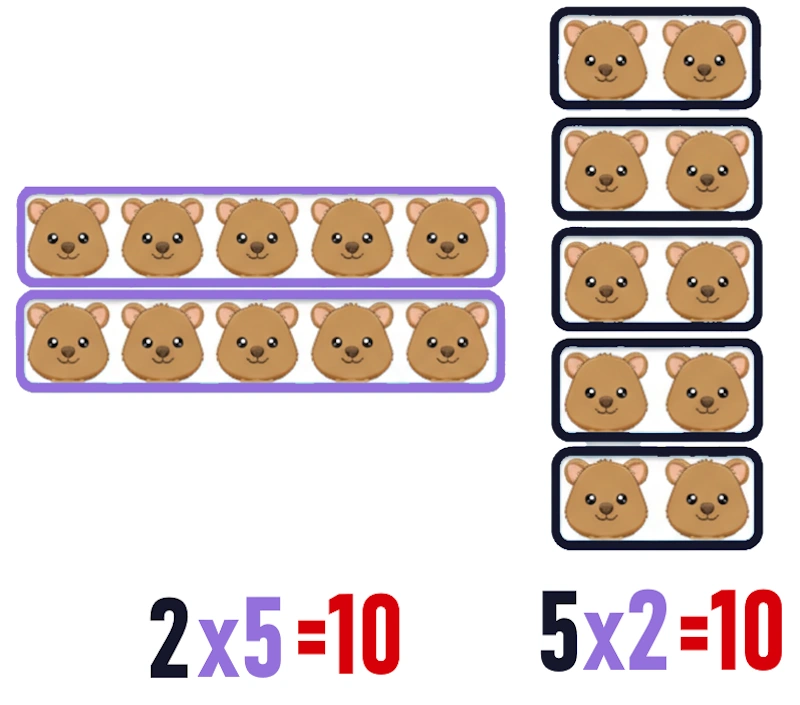
Visualising arrays helps students understand that rotating the factors does not change the product—a key mental model for Year 3 multiplicative thinking.
Strategy B: The Inverse Relationship (Fact Families)
Division shouldn't be taught as a "new" or separate skill. We teach students that multiplication and division are inverse operations. If a student knows 3 x 10 = 30, they already have the "mental map" to solve 30 ÷ 3. Using fact family triangles prevents division anxiety by grounding it in known multiplication facts.
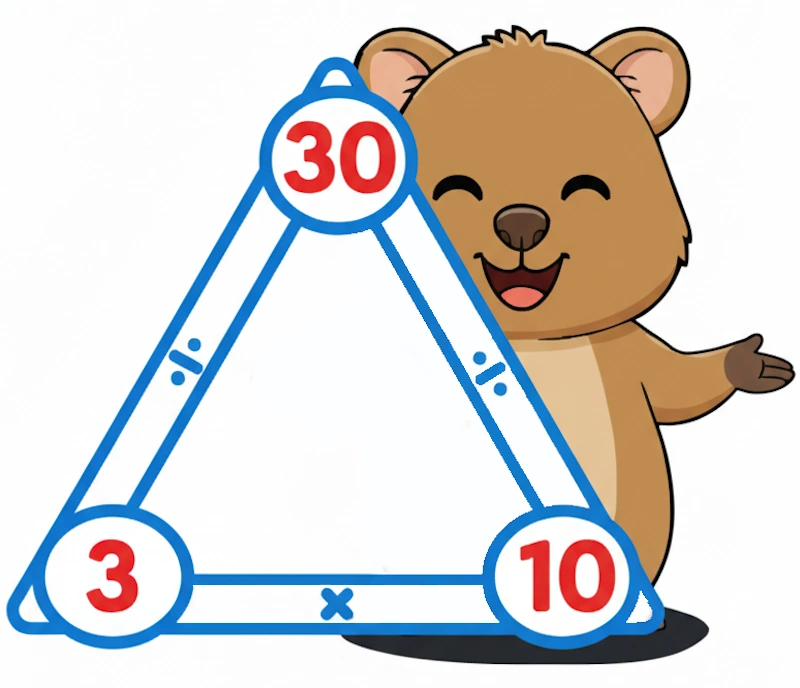
Fact Family Triangles help students internalise the connection between factors and products, making division a natural extension of multiplication.
Strategy C: Zero and One Properties
Students often try to "count" when they see 10 x 0. We teach the Identity Property (any number x 1 is itself) and the Zero Property (any number x 0 is zero) as "The Cheats." These should be the first facts mastered to build early confidence.
Build Year 3 Automaticity
Use these PerciGo modules to transition students from concrete strategies to high-speed recall.